Material risk · Irregular rainfall, drought and shade-tree stress on smallholder Arabica livelihoods · Ethiopia
Executive briefing. Reporting quarter Q3 2026 leaves 100 days until Regulation (EU) 2023/1115 applies to large and medium operators from 30 December 2026 (micro and small from 30 June 2027) under the dates fixed by Regulation (EU) 2025/2650 [1]. Coffee is a listed commodity. The climate load is already on the hectare: USDA’s May 2026 Coffee Annual for Ethiopia names irregular rainfall and drought as continuing production constraints while labour and inland freight costs climb [4]. Harvest desks covering the 2025/26 campaign describe a later start, southern volume stress and western bumper pockets — an uneven climate year, not a brochure average [2][3]. Peer-reviewed survey work records drought, heat and drying shade trees as lived farmer experience [5]. Landscape agroforestry research shows shade management and canopy structure shift yield outcomes under climate shock [6]. The Institute’s question is whether European offtake finances living shade and origin-held geolocation — or captures “regen coffee” language while the smallholder absorbs weather and compliance friction alone.
01The macro challenge: climate on the coffee hectare, countdown on the statute
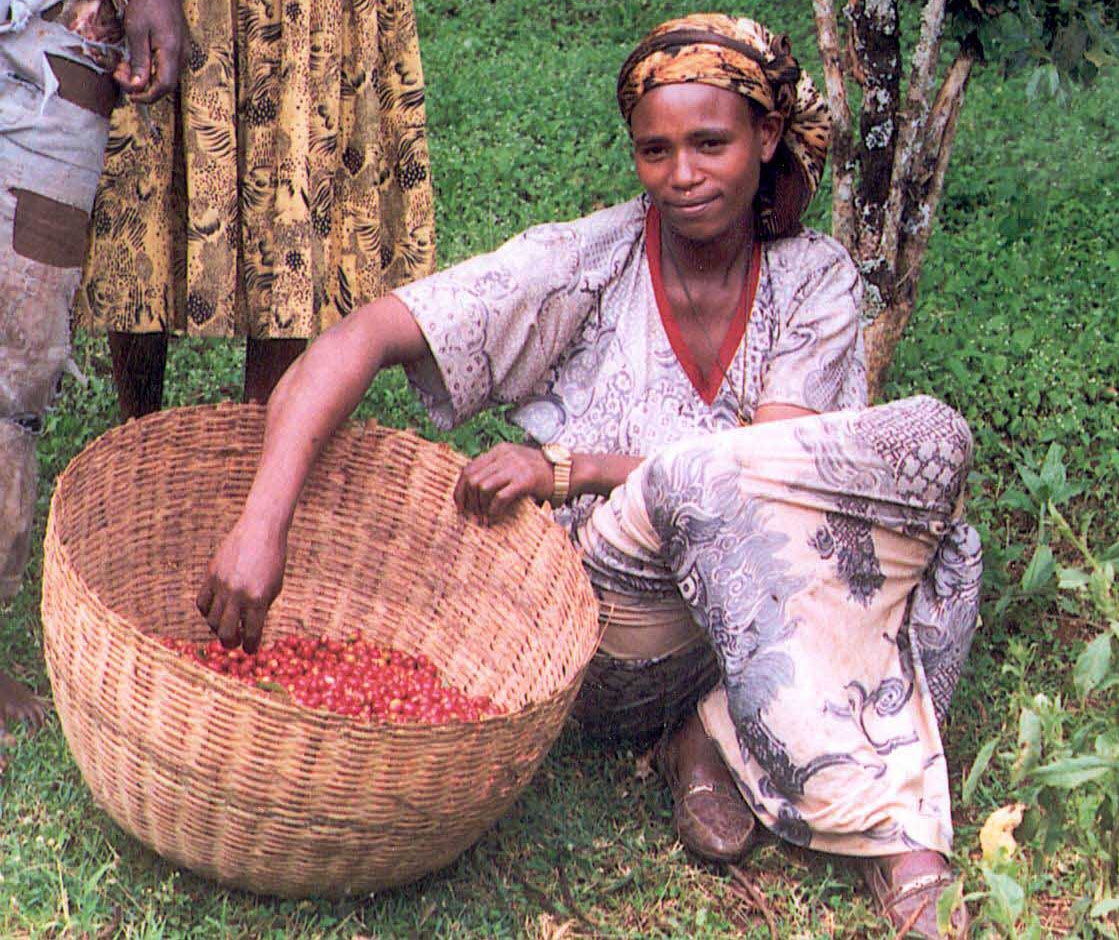
Ethiopia’s coffee economy is a smallholder system first. USDA cites Ethiopian Coffee and Tea Authority figures that roughly 5.9 million farmers produce coffee and that smallholders account for about 90 percent of national output, typically on plots averaging less than half a hectare and often in mixed systems with food crops [4]. That structure is precisely why irregular rain and drought are food-security and farmer-cost stories as well as export stories. Post’s May 2026 outlook forecasts MY 2026/27 production near 12.1 million bags under an assumption of favourable weather, while stressing that weather-related shocks — irregular rainfall patterns and drought — remain significant concerns that can worsen disease pressure [4]. Sidama wet-mill labour costs for cherry picking are reported to have doubled in places from five to ten birr per kilogram, with inland transport costs rising as fuel prices surged more than 30 percent season-on-season [4]. Climate stress and cost stress arrive together.
As covered in Trabocca’s Ethiopia Harvest 2025/26 desk note, the campaign started two to three weeks later than usual; southern regions reported lower productivity while western Ethiopia saw bumper yields, with dry weather during peak harvest supporting drying conditions [2]. Efico’s Cuprima press on the same season likewise reports smaller southern volumes, cherry prices at historic highs in Sidama/Guji/Yirgacheffe belts, and rising labour and production costs pressuring margins [3]. Those are contemporaneous trade observations of an uneven climate year. They are not a licence for European brands to treat Ethiopian coffee as an abstract Scope 3 line item while privatising the compliance narrative.
Specialty demand in Europe and the United States still wants character and altitude; China is rising as a volume buyer in the USDA account [4]. Multi-offtaker clusters only work if the origin shade and geolocation file can travel after a shock without each retailer demanding a new exclusive data enclosure. That is the practical meaning of origin title under a 100-day EUDR countdown: the same cooperative ledger must satisfy more than one offtaker, or the smallholder will be forced into serial compliance rents while the canopy that buffers Arabica remains unpaid [1][4].
| Signal | What the 2025/26–2026 record shows | Who must hold the file |
|---|---|---|
| Weather constraint | Irregular rainfall and drought named as production risks [4] | Producer / cooperative climate ledger |
| Regional harvest split | Southern stress; western bumper; delayed start [2][3] | Origin unions and washing stations |
| Farmer cost | Labour and transport cost spikes alongside climate risk [4][3] | Offtake pricing that absorbs shock — not only FOB talk |
| Shade / drought lived experience | Farmers report yield loss and drying shelter trees [5] | Plot agroforestry practice log |
| Shade under climate shock | Leguminous shade and canopy openness matter; effects shift in El Niño years [6] | Farmer-managed canopy, not retailer storyboard |
| EUDR clock | Large/medium from 30 Dec 2026; micro/small 30 Jun 2027 [1] | Geolocation and DDS at origin title |
02The transitional opportunity: living shade before the due-diligence enclosure
Megerssa and colleagues’ 2025 mixed-methods study of Ethiopian Arabica value chains documents climate change as rising temperature, changing rainfall, disease pressure, post-harvest loss and shifting suitable areas — with severe drought cited by farmers as a major recent production challenge, including drying of trees that shelter coffee [5]. That is regenerative agriculture as practised at smallholder scale: shelter trees, moisture and microclimate on the plot — not a CPG credit methodology. Morel and colleagues show that in East African smallholder coffee, leguminous shade and low canopy openness generally benefit yields, while climate-shock years dominated by drought or high temperatures reverse or complicate those relationships [6]. The transitional opportunity is therefore to finance and measure shade and soil practice as origin-owned observation objects that can travel into EUDR due diligence without surrendering title to a buyer portal.
USDA notes that Ethiopia’s predominantly smallholder systems may offer a structural association with lower deforestation risk under EUDR, while also warning that the same structure complicates geolocation and compliance data collection [4]. That is the Institute’s hinge. Plot polygons and practice histories must be built with cooperatives and kebeles — not scraped exclusively into European operator systems that leave the farmer without an inspectable copy. Stumping and improved cultivars appear in the USDA production narrative as yield tools [4]; they do not replace shade as the climate buffer farmers already name when shelter trees dry [5]. The same USDA brief records that nearly 70 percent of Ethiopia’s coffee trees are old, that a national stumping campaign now covers a material share of harvested area, and that Sidama and southern belts can see yield jumps after rejuvenation — yet none of that erases the weather-shock line the report keeps open [4]. Shade and rejuvenation are complementary; buyer software is not a substitute for either.
Harvest desks covering 2025/26 make the farm-gate cost channel explicit. As covered in Trabocca, Tesfaye Bekele of Suke Quto reports picking costs that have moved from day rates near 50 ETB to per-kilogram cherry rates up to 50 ETB — a concurrent labour shock beside the climate-uneven crop [2]. Efico’s Cuprima note places cherry prices in southern belts at historic highs while washed volumes tighten and EU-organic availability declines [3]. Those are the numbers European offtakers will meet in contracts: higher origin cost, thinner washed supply, and a compliance clock that still demands plot files. Financing living shade without financing the labour and verification capacity that keep shade standing is incomplete stewardship.
03The Institute analyst take: EUDR cannot rewrite who owns the canopy file
Regulation (EU) 2023/1115 lists coffee among the relevant commodities and requires deforestation-free due diligence with geolocation of production plots [1]. The application calendar, as amended by Regulation (EU) 2025/2650, now runs from 30 December 2026 for most operators and 30 June 2027 for qualifying micro and small operators [1]. One hundred days from this briefing’s publication date is not “plenty of runway” for five-plus million smallholders if the only investment thesis is importer software. Corporate regenerative rhetoric that markets “climate-smart Ethiopian coffee” while contracting on price-only terms and retaining exclusive claim to farm data is language capture. Technology is legitimate only if origin retains the primary observation, the margin after climate loss, and the ability to show the same file to more than one offtaker.
As covered in Trabocca’s harvest desk, the farm-gate labour and cherry-price spike is already concurrent with the climate-uneven crop [2]. Efico similarly flags firm prices, limited washed volumes and declining availability of EU-certified organic lots as buyers delay [3]. Those commercial pressures will intensify as EUDR documentation costs land. If European F&B manufacturers treat geolocation as a private assurance asset while shade restoration remains an unpaid public good, the statute will have cleaned the import declaration without repairing the hectare. The Institute’s systemic optimism sits on the opposite architecture: cooperative-held canopy and polygon ledgers that satisfy Article 9-style information needs without dispossessing the producer.
"weather-related shocks such as irregular rainfall patterns and drought remain significant concerns. These shocks may also exacerbate disease pressure, further affecting yields and quality." USDA Foreign Agricultural Service, Coffee Annual — Ethiopia (GAIN ET2026-0005), May 2026 [4]
That institutional line is the material-risk anchor for Q3 2026. It is also the reason regenerative canopy work cannot be postponed until after a European operator’s first due-diligence statement. Food insecurity and farmer cost rise when irregular rain cuts southern volume while labour and fuel inflate the residual crop [4][3][2]. Offtakers who want Ethiopian Arabica character in 2027 will need living trees and titled files in 2026 — not a portal demo that discovers the drought after the washing station already ran short.
As covered in Trabocca’s 2025/26 harvest desk, the southern-versus-western split is already a contract fact, not a future scenario:
"While the harvest started two to three weeks later than usual, the last cherries from Ethiopia’s highest-altitude areas are now being picked. Producers and exporters report lower productivity in southern regions, while western Ethiopia is experiencing a bumper year with increased yields." Trabocca, Ethiopia Harvest 2025/26 desk note, June 2026 [3]
That regional asymmetry is why a single European “Ethiopia coffee” ESG slide fails. Shade finance and geolocation must follow the hectare that actually grew the cherry — Sidama stress and western bumper alike — under cooperative title [3][2][4].
04The proactive resolution: shade ledgers and portable polygons before 30 December
Finance living shade and water-conserving agroforestry on the plots USDA and harvest desks already mark as climate-exposed [4][2][3][5][6]. Build geolocation and practice histories under cooperative title so EUDR due diligence can cite an origin file rather than invent a buyer enclosure [4][1]. Price offtake so labour and climate shocks do not fall entirely on smallholders while brands book a resilience story [4][2][3]. Stewardship closes when the canopy that buffers Arabica remains Ethiopian property after the compliance clock hits zero.
One hundred days is enough to start cooperative shade and polygon programmes; it is not enough to invent them after the first operator penalty narrative. Buyers who need Ethiopian lots through 2027 should treat living canopy and titled geolocation as contract conditions now — financed at origin, inspectable by the farmer, portable across offtakers [1][4][6].
Editorial infrastructure note. Origin-held land-use and forest monitoring tools that cooperatives can operate without surrendering the primary record — for example public open-source stacks such as Open Foris — illustrate the architectural model under discussion. Commercial importer dashboards remain a different layer. The Institute holds no commercial relationship with providers named here unless this block is labelled Sponsored Insight.
What to demand before the December EUDR gate
One action per reader while the countdown still has three-digit days.
Cooperatives & producers
Treat shade and polygon files as titled assets; refuse exclusive lock-in to a single offtaker portal.
Agro-exporters
Co-finance canopy restoration and washing-station digital capacity; share climate revisions with growers first.
F&B / FMCG buyers
Pay for living shade and portable due-diligence objects; do not rebrand climate loss as supply-chain theatre.
NGOs & development programmes
Fund plot verification middleware farmers can inspect — not another seal that leaves the file offshore.
Ethiopia’s coffee briefings will be judged on whether the canopy and the compliance clock move together under origin title — not on how quickly a European operator can populate a due-diligence statement after the rain failed.
References and citation matrix
Published by The Global Risk & Regeneration Institute as independent regulatory analysis. This briefing does not constitute legal, tax, or investment advice. Platforms named in the editorial infrastructure note are cited as architectural examples; the Institute holds no commercial relationship with them.